Why Rich-Looking Lifestyles Often Delay Actual Wealth
Modern culture makes it incredibly easy to look wealthy. Building actual wealth, however, often requires doing the exact opposite of what looks impressive from the outside.

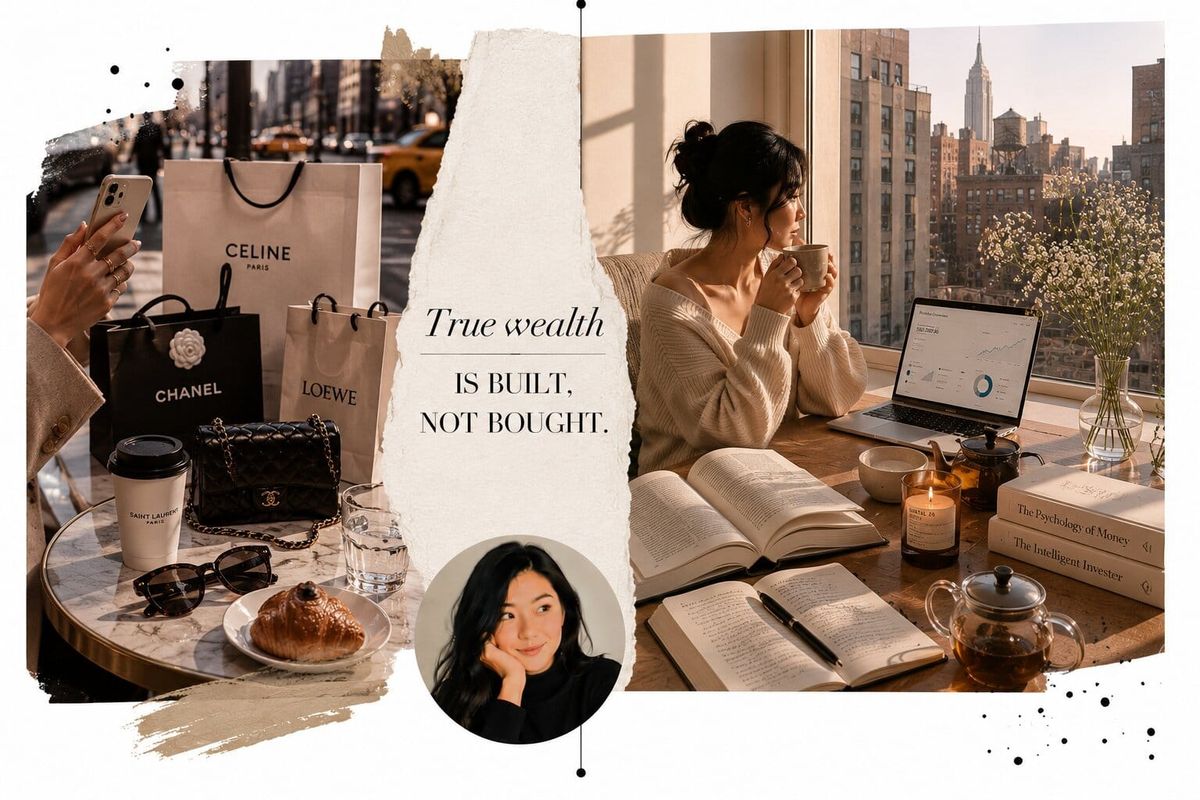
A few years ago, I walked through one of the wealthiest neighborhoods in Manhattan and had a strange thought.
Everyone looked rich.
Luxury handbags. Luxury cars. Luxury fitness studios. Luxury coffee. Luxury dogs, somehow.
And yet I knew, statistically speaking, that many of the people around me were probably carrying significant debt, living paycheck to paycheck, or feeling enormous financial pressure behind the scenes.
That realization stayed with me because it highlighted something modern society rarely talks about:
Looking wealthy and becoming wealthy are often two completely different financial paths.
And surprisingly often, the first one delays the second.
The Millionaire Next Door Had a Different Story
One of the most fascinating discoveries in The Millionaire Next Door was that many genuinely wealthy people did not live flashy lifestyles. Instead of maximizing visible consumption, they focused on saving, investing, and maintaining a gap between income and spending.
That finding surprised many readers because it directly contradicted the popular image of wealth.
The authors found that many millionaires drove ordinary cars, lived in reasonably priced homes, and spent far less on status symbols than society expected.
In other words, they prioritized ownership over appearance.
And ownership is where wealth actually lives.
The Expensive Trap of Looking Successful
The challenge today is that social media has dramatically increased the visibility of consumption.
People no longer compare themselves only to neighbors, coworkers, or friends.
They compare themselves to thousands of carefully curated lifestyles every week.
That creates subtle pressure to upgrade constantly:
- A nicer apartment
- A newer car
- More expensive vacations
- Designer clothing
- Luxury beauty products
- Premium versions of everything
Individually, none of these purchases are necessarily bad.
The problem begins when lifestyle upgrades happen automatically instead of intentionally.
Because every dollar spent maintaining a rich-looking lifestyle is a dollar that cannot be invested, saved, or used to create future financial freedom.
That's the hidden tradeoff people rarely talk about.
The "Future Naomi" Test
Whenever I feel tempted by a major lifestyle upgrade, I ask myself: "Would Future Naomi rather have this purchase, or the investment growth this money could create over the next decade?" The answer isn't always obvious, but the question forces me to think beyond the present moment.
Lifestyle Inflation Wears Nice Clothes
One of the reasons rich-looking lifestyles are so seductive is that they rarely arrive all at once.
Lifestyle inflation happens gradually.
A salary increase leads to slightly higher rent. Higher rent leads to a different social circle. A different social circle creates new spending norms. Those norms slowly become expectations.
Eventually, luxuries begin to feel like necessities.
Psychologists call this hedonic adaptation. Humans quickly adjust to improvements, causing yesterday's luxury to become today's baseline.
And once something feels normal, giving it up feels like a loss.
Even if it never improved your happiness very much in the first place.
The Wealth Nobody Can See
Morgan Housel writes that wealth is hidden.
You can see spending.
You can see consumption.
You can see status symbols.
But you cannot easily see:
- A healthy investment portfolio
- An emergency fund
- Low debt levels
- Financial flexibility
- Years of consistent saving
- The ability to walk away from unhealthy situations
Those things rarely attract attention.
But they create something far more valuable than attention:
options.
And options are one of the purest forms of wealth.
Choosing Financial Freedom Over Financial Theater
The older I get, the less interested I become in financial theater.
The constant performance of success starts feeling exhausting.
What interests me now is financial freedom.
Not necessarily retiring early on a private island.
Just having enough stability that money creates choices instead of pressure.
The freedom to leave a bad job. The freedom to take a break. The freedom to handle emergencies without panic. The freedom to make decisions based on values instead of immediate financial survival.
Ironically, those benefits rarely come from looking wealthy.
They come from quietly building wealth behind the scenes.
And that process is often much less visible than people expect.
Looking wealthy can be purchased immediately. Building wealth usually takes years.
The challenge is deciding which version of success matters more. Because every financial decision is ultimately a vote for one of those futures.