Why Comfort May Be the Most Expensive Thing You Ever Buy
Most people think financial success comes from avoiding mistakes. But what if the biggest threat to your future wealth isn't taking risks—it's avoiding them? Discover the hidden cost of comfort and why waiting for certainty can be far more expensive than making the wrong move.


THE HIDDEN PSYCHOLOGY OF EVERYDAY MONEY
The Comfort Trap: How Playing It Safe Is Costing You a Fortune
The biggest financial risk in your life may not be the risks you're taking—it may be the ones you're avoiding.
I once met a man who seemed to have done everything right.
He had a stable career. A respectable income. A comfortable home. He avoided debt whenever possible and always kept a healthy emergency fund.
From the outside, he looked like the definition of financial responsibility.
Yet during our conversation, he admitted something unexpected.
"I feel stuck."
Not broke.
Not unemployed.
Not unhappy.
Just stuck.
As we talked, a pattern emerged. Every major decision in his life had been guided by one question:
"What's the safest option?"
He stayed in jobs longer than he wanted. Delayed investments until he felt completely ready. Passed on opportunities that seemed uncertain.
And while those choices protected him from many mistakes, they also protected him from growth.
That's when I realized something fascinating:
Many people spend their lives avoiding small risks while quietly accepting enormous hidden costs.
Why Our Brains Love Safety
Human beings are wired to seek certainty.
For most of history, uncertainty often meant danger. The ancestors who avoided unnecessary risks were more likely to survive and pass on their genes.
That ancient survival mechanism still shapes our decisions today—even when the risks we face are financial rather than physical.
Psychologists Daniel Kahneman and Amos Tversky discovered that losses tend to feel about twice as painful as equivalent gains feel rewarding.[1]
In practice, that means losing $1,000 hurts more than gaining $1,000 feels good.
This tendency, known as loss aversion, influences countless financial decisions.
We postpone investing because markets might decline.
We stay in comfortable jobs because another role might not work out.
We delay ambitious projects because they might fail.
Often, we call this caution.
Sometimes it's simply fear wearing a more respectable outfit.
The Hidden Cost of Comfort
Most financial costs show up on a bank statement.
The most expensive ones usually don't.
They appear as opportunities that never happened.
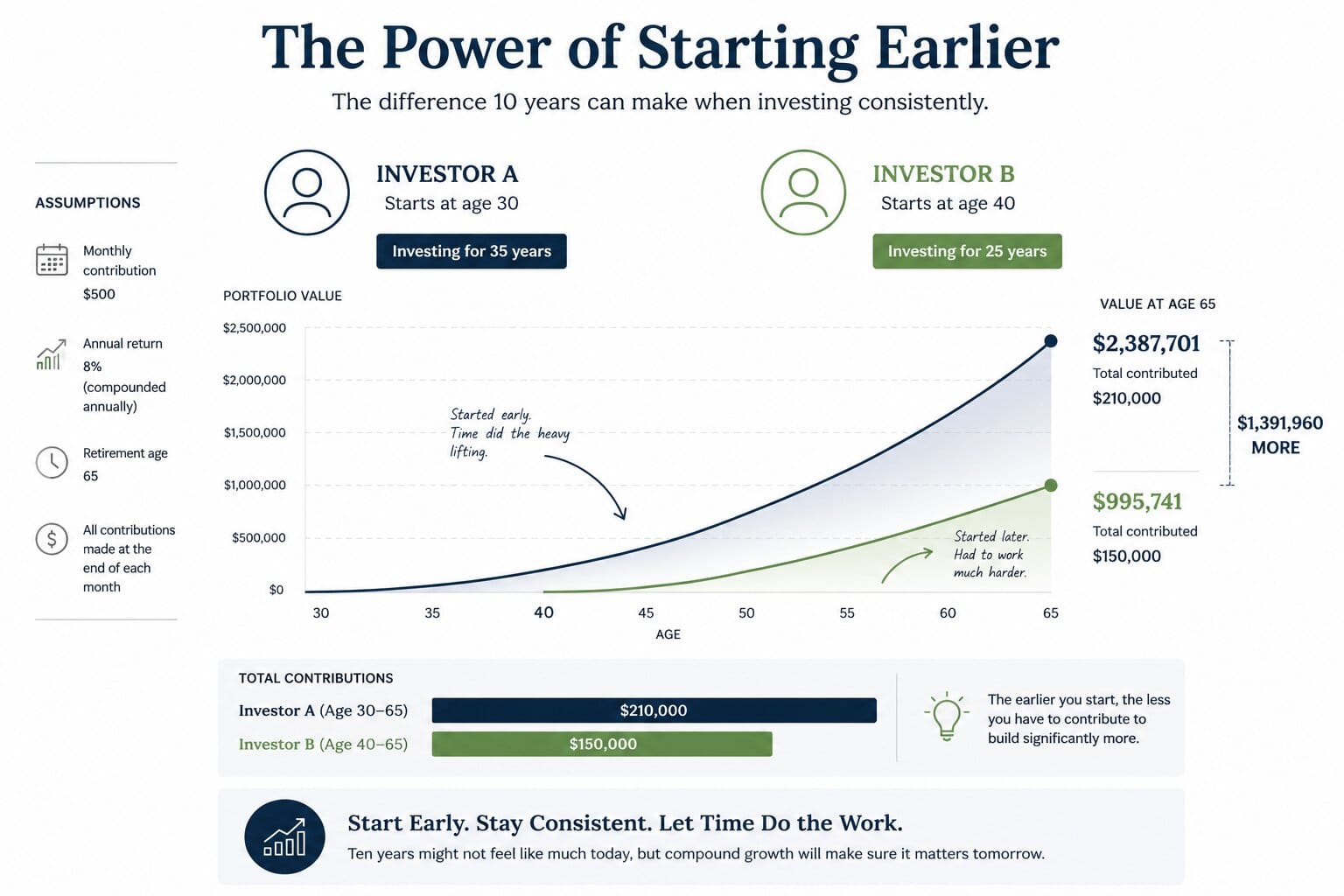
Imagine two people who both plan to invest $500 per month.
The first starts today.
The second waits ten years until they feel more financially secure.
Assuming a long-term return of 8%, the person who starts earlier could end up with hundreds of thousands of dollars more by retirement.[2]
Not because they were smarter.
Not because they earned more.
Simply because they acted before certainty arrived.
The Comfort Tax
Every year spent waiting for perfect certainty is a year that compound growth cannot work in your favor.
And investing isn't the only place where this happens.
The same pattern appears in careers, businesses, relationships, and personal goals.
Many of the opportunities that shape our lives arrive disguised as uncertainty.
The Great Illusion of Safety
One of the most interesting lessons I've learned about money is that many things we consider safe aren't actually safe at all.
A stable job can disappear.
A thriving industry can decline.
A savings account can quietly lose purchasing power to inflation.[3]
A carefully planned future can change overnight.
The truth is simple:
Life is uncertain whether we acknowledge it or not.
Some people spend enormous amounts of time, energy, and money trying to eliminate uncertainty.
Others focus on becoming resilient enough to handle it.
The second group usually ends up with more freedom.
And often, more wealth.
A Different Definition of Security
Real security doesn't come from eliminating risk. It comes from developing the skills, confidence, and adaptability needed to navigate it.
The Wealth-Building Skill Nobody Talks About
Most financial advice focuses on budgeting, saving, and investing.
All important topics.
But beneath every financial outcome lies a more fundamental skill:
The ability to act before certainty arrives.
Every meaningful investment involves uncertainty.
Every career move involves uncertainty.
Every business involves uncertainty.
Every worthwhile goal involves uncertainty.
The people who build extraordinary lives are rarely fearless.
They're simply willing to move forward before all the answers appear.
And over time, that willingness compounds just as powerfully as money itself.
Comfort feels good.
That's why our brains crave it.
But comfort has a habit of sending invoices years later.
The promotion never pursued.
The investment never made.
The business never started.
The opportunity never explored.
Most of those losses never appear on a financial statement.
Yet they may become the largest financial losses of all.
The next time you're waiting for perfect certainty, ask yourself a different question:
What is the cost of staying comfortable?
Because sometimes the safest choice today creates the riskiest future tomorrow.
References
[1] Kahneman, Daniel & Tversky, Amos (1979). Prospect Theory: An Analysis of Decision Under Risk.
https://www.jstor.org/stable/1914185
[2] U.S. Securities and Exchange Commission – Compound Interest Calculator & Long-Term Investing Principles.
https://www.investor.gov
[3] Federal Reserve Bank – Historical Inflation Data and Purchasing Power Research.
https://fred.stlouisfed.org